Podgorica, the Capital of Montenegro: What to See as a Tourist
If you ask someone who has never explored the Balkans where the capital of Montenegro is, they may hesitate. Podgorica is not as famous as the Adriatic resorts, yet anyone who has spent time on the Montenegro coast knows that this is the country’s main city and an important stop beyond the beaches.
Podgorica is worth visiting not only as the administrative center of Montenegro. The city combines old bridges, Orthodox churches, monuments, lively squares, the emerald Moraca River, and scenic natural spots nearby. It fits perfectly into a wider Montenegro itinerary if you want to see more than seaside resorts and discover the inland character of the country.
.jpg "Podgorica")
Podgorica is the capital of Montenegro.
A Brief History of Podgorica
Podgorica is considered one of the oldest settlements in Southern Europe. Archaeological discoveries show that people lived here as far back as the Stone Age. Thanks to its favorable location, the settlement remained an important economic point for centuries, even though its name changed more than once over time.
The modern name Podgorica appeared in the early 14th century. It comes from Gorica Hill, which rises above the city. Podgorica officially became the capital in 1949.
Top Things to See in Podgorica
For a first visit, focus on the city’s best-known landmarks: the Cathedral of the Resurrection of Christ, the Old Bridge on the Ribnica, Millennium Bridge, the Clock Tower, Republic Square, the monuments to Vladimir Vysotsky and Alexander Pushkin, St. George Church, and the Moraca River. If you have extra time, Bukumirsko Lake in the surrounding area is also worth adding to your route.
- Cathedral of the Resurrection of Christ
- Old Bridge on the Ribnica
- Millennium Bridge
- Monument to Vladimir Vysotsky
- Bukumirsko Lake
- St. George Church
- Clock Tower
- Monument to Alexander Pushkin and Natalia
- Republic Square
- Moraca River
Cathedral of the Resurrection of Christ
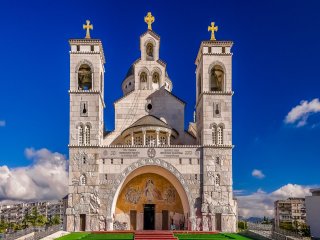
Cathedral of the Resurrection of Christ in Podgorica.
The Cathedral of the Resurrection of Christ stands out for its neo-Byzantine architecture, which is especially striking in Podgorica. It is a relatively new church: construction began in 1993 on the site where the Church of the Holy Apostles once stood.
Patriarch Alexy II of Moscow personally visited the site and laid the first brick. The project lasted for more than twenty years, and in 2014 the cathedral opened to pilgrims and visitors. Today it is one of the most recognizable symbols of Orthodox Montenegro.
Travelers come here to admire the interior decoration, frescoes, architecture, and bell tower, where an 11-ton bell is installed. During services, the church also remains an active place of prayer.
Old Bridge on the Ribnica
The Ribnica River flows near the city center, and a stone bridge built in the 16th century crosses it. Locals often call it the Old Bridge. It is associated with a romantic tradition: couples come here to promise each other eternal love.
In earlier centuries, the bridge led travelers toward a small church, of which only ruins survive today.
Millennium Bridge
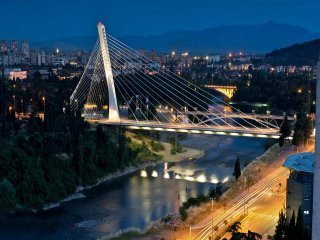
Millennium Bridge over the Moraca River.
Built in 2005, Millennium Bridge has already become one of Podgorica’s modern icons. It links the old and new parts of the city and offers pleasant views over the river and surrounding neighborhoods. In the evening, the illuminated structure looks especially impressive.
The bridge spans the emerald Moraca River, which descends from the Moraca River Canyon, passes by the Moraca Monastery, and eventually flows into Skadar Lake. The bridge project was sponsored by Elena Baturina.
Monument to Vladimir Vysotsky
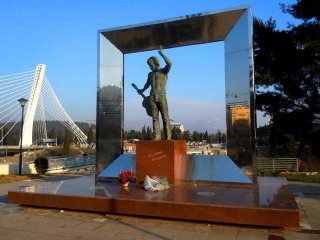
Monument to Vladimir Vysotsky in Podgorica.
The monument to Vladimir Vysotsky is one of the city’s reminders of the long cultural ties between Montenegro and Russia. It was installed in 2004 by a Russian sculptor.
Vysotsky visited Yugoslavia many times, loved Belgrade, and also came to Montenegro for отдых. A number of his poems and songs were written here. The monument shows the poet and actor, and the pedestal includes lines from his poetry in two languages.
I was not born enough one time,
I should have grown from two strong roots,
What a pity Montenegro never became
my second homeland.
Bukumirsko Lake
Podgorica’s surroundings are interesting not only for city sightseeing but also for nature. Bukumirsko Lake is a round mountain lake with a depth of up to 17 meters.
According to local legends, dragons once lived here, and some say they still do. The lake is also considered one of the cleanest in Montenegro.
St. George Church
St. George Church is one of the oldest buildings in Podgorica and one of the historic churches of Montenegro. It dates back to the 11th century and stands not far from the central part of the city.
This church is worth visiting for its atmosphere alone. Although it was partially destroyed in the past and later restored, it still preserves a strong sense of antiquity. Visitors are especially interested in the old frescoes by an unknown painter and the protected sacred objects kept here.
Clock Tower
The Clock Tower is one of the notable historic attractions of Montenegro, built in the second half of the 17th century.
It appeared during the Ottoman period, when the tower served as an observation point over the city and helped monitor the surrounding area. It also functioned as a minaret. The tall square structure is crowned with a bell.
Monument to Alexander Pushkin and Natalia
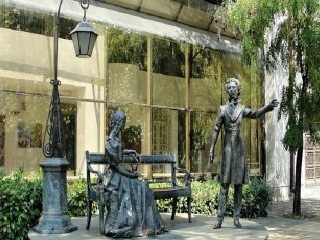
Monument to Alexander Pushkin and Natalia in Podgorica.
The monument to Alexander Pushkin and his wife Natalia was presented by Moscow to Montenegro and its people. Installed in 2002 by Russian sculptors, it became another symbol of the cultural connection between the two countries.
The composition captures Pushkin reciting poetry while Natalia listens. On the pedestal are lines dedicated to Montenegro:
Montenegrins? What are they?
Bonaparte once asked,
Is it true this fierce tribe
does not fear our strength?
Republic Square
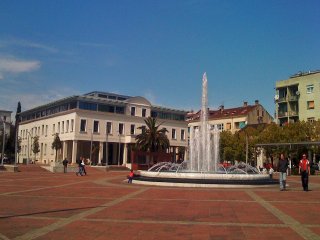
Republic Square in Podgorica.
Republic Square is the city’s main and largest square, covering around 15,000 m². A tall fountain and magnolia trees give the area a pleasant, open feel. Public celebrations, fairs, and city events are often held here.
There are also many boutiques and small shops around the square, making it a convenient stop during a walking tour.
Moraca River
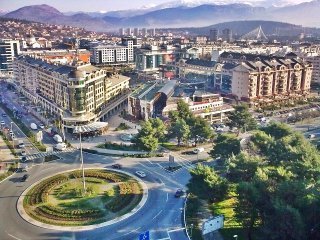
Podgorica and the natural scenery of Montenegro.
The Moraca River runs through much of Podgorica and is considered one of the most beautiful rivers in Montenegro. Its water is known for its clear emerald color.
The river comes from northern Montenegro and flows into Skadar Lake. In summer the water level drops, while in spring, especially after snowmelt and heavy rains, it can rise by 4 to 5 meters.
During the warm season, locals come here to fish for trout and swim in the cool water to escape the summer heat. If you are interested in Montenegro’s natural highlights beyond Podgorica, the Tara River Canyon is another famous destination worth knowing about.
These are only some of the places tourists usually include in their Podgorica route. The city also has the Petrovic-Njegos Palace, an old Ottoman fortress, and several museums.
Podgorica in One Day
If you only have one day in the capital, it is best to follow a compact route that covers the city’s main highlights without making the schedule too heavy. This way you can see Podgorica’s religious, historical, cultural, and natural sides in a single trip.
- Start at the Cathedral of the Resurrection of Christ.
- Continue to Millennium Bridge and the Moraca River.
- Walk to the Old Bridge on the Ribnica.
- Visit the Clock Tower.
- Spend some time at Republic Square.
- See the monuments to Vladimir Vysotsky and Alexander Pushkin.
- If time allows, add St. George Church or Bukumirsko Lake outside the city.
Excursions and Trips That Include Podgorica
Travelers come to Podgorica not only because it is the capital, but also to explore its landmarks. If you are staying in a resort area such as Budva or Becici, the city is easy to visit as part of an organized day trip. On the website you can browse excursion routes in Montenegro, compare group tours, or choose an individual program that includes Podgorica. A separate option worth noting is the trip to Ostrog Monastery and Podgorica, ideal for those who want to combine the capital with one of Montenegro’s best-known shrines.
How to Choose the Right Trip Format
You can visit Podgorica in several ways: with a group, on a private itinerary, by transfer, or independently. The best choice depends on whether you simply need transport or prefer a ready-made route with sightseeing included.
| Format | Who It Suits | Where to Check |
|---|---|---|
| Group trip | For travelers staying on the coast who want a ready-made program. | Group tours |
| Ostrog and Podgorica | For those who want to combine the capital with Ostrog Monastery. | View route |
| Private program | For travelers who need a more flexible itinerary with Podgorica included. | Private trips |
| Taxi transfer | For those who need a direct ride without the excursion part. | Book transfer |
| Independent trip | For tourists who prefer to plan the road and stops in advance. | Budva — Podgorica |
How to Get to Podgorica
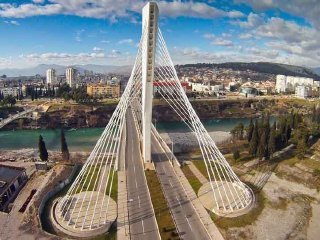
Millennium Bridge is one of the symbols of modern Podgorica.
There are several ways to reach Podgorica. Visitors arriving in Montenegro can travel to the capital by plane. If you are staying in a resort area such as Budva or Becici, an organized trip with departure from your holiday location can be one of the most convenient options.
Another practical solution is a direct transfer, for example on the Budva–Podgorica route. You can book a taxi transfer in Montenegro on the website. Detailed information about the route between the country’s most popular resort and the capital is available on the Budva — Podgorica page.
Podgorica on the Map
Podgorica is located in the inland part of Montenegro. The map below helps you understand where the capital lies in relation to the coast and other popular destinations.
Video About Podgorica
This video gives a better sense of the city’s atmosphere, its bridges, streets, and views of Montenegro’s capital.
FAQ: Podgorica for Tourists
What should you see first in Podgorica?
Start with the Cathedral of the Resurrection of Christ, Millennium Bridge, the Old Bridge on the Ribnica, the Clock Tower, Republic Square, and a walk along the Moraca River.
Can you see Podgorica in one day?
Yes. One day is enough to cover the main city highlights: churches, bridges, monuments, the central square, and riverside areas.
Which churches are worth visiting in Podgorica?
The two main religious landmarks are the Cathedral of the Resurrection of Christ and St. George Church. The first is known for its neo-Byzantine style and 11-ton bell, while the second dates back to the 11th century.
Why is Millennium Bridge interesting?
Built in 2005, it connects the old and new parts of Podgorica, crosses the Moraca River, and looks especially beautiful in the evening lighting.
How can you travel to Podgorica from Budva or Becici?
You can choose an organized excursion, a private itinerary that includes Podgorica, or a taxi transfer. There is also a separate page on the Budva–Podgorica route.
What can you see near Podgorica?
Bukumirsko Lake is one of the nearby natural attractions. The Moraca route is also connected with the Moraca Canyon, Moraca Monastery, and Skadar Lake.
Expert Guide and Commercial Travel Advice from a Local Operator
How to choose, where to book, and what to check before reserving excursions in Montenegro.
- Author: OLIMPUS.me editorial team
- Verified by: local excursion specialist at OLIMPUS.me
- Updated: June 9, 2026
- Topics: Podgorica, capital of Montenegro, Podgorica attractions, one-day Podgorica itinerary, Cathedral of the Resurrection of Christ, Millennium Bridge, Old Bridge on the Ribnica, Moraca River, Clock Tower, monuments to Vysotsky and Pushkin, Bukumirsko Lake, trips to Podgorica, Ostrog and Podgorica route, Budva — Podgorica transfer.
